Not running in 2012

I'm making this prediction: John Ensign, Mark Sanford, and Sarah Palin are not running for the Republican nomination in 2012.

AnonGuy gets it right,
Considering she is bailing on her one and only term as Governor, I suspect Mitt Romney, Newt Gingrich, Haley Barbour, Mike Huckabee, Tim Pawlenty, etc., are drooling at the chance to paint her as someone who can't finish the job. Or, in these tough economic times, can't stand the heat. I can see the 30-second spots attack spots already, "She couldn't even finish one term as governor of a small state ... now she wants to run our country?"

But of course, somewhere on the Tubes, someone is trying to spin this as a convoluted plan to position for 2012. Blogs for Victory provides the first hit,
Fabulously popular, a certainty for re-election in 2010…and now she leaves?

Perhaps she’s just sick of the nastiness? If so, then we’re to blame, as a country, for failure to sustain someone as good as she is…

Perhaps her family just wants a year off prior to a Presidential run? Remember, if she ran for re-election she’d be busy in 2010 and then in 2011 its off to the races…


But leave it to Politico to go the extra mile, going so far as to tell Palin there are 7 things she must do,
Those who underestimate her do so at their own risk. She projects a tough but warm personality. Her most famous line — “You know what they say the difference is between a hockey mom and a pit bull? Lipstick!” — reflects that. She is a conservative in an increasingly conservative party.

True, the GOP's gotten a lot more conservative, but they'll figure out after 2010 that extremism won't beat Obama. Competence will.

Yeah, Pawlenty's declining re-election too, to focus on 2012, but Pawlenty's not running away from an ethics probe. There's a difference between taking a break in preparation for a run and bailing out of your career mid-term like it's a doomed airplane.

It's still Mitt Romney's to lose.

Hooray, Artomatic! Boo, venue!

I finally went to Artomatic today and saw floors 3 and 4. I also walked around the work-in-progress Waterfront area around Nationals Park. I'm not a really a baseball fan, so it's not a neighborhood I would go to, but art puts me in an ambitious and introspective mood, so now I want to write about what I saw.

The first thing I walked away thinking was, unfortunately, how much I disliked the area's new architecture. And this is especially troubling for me, because I normally love contemporary architecture.

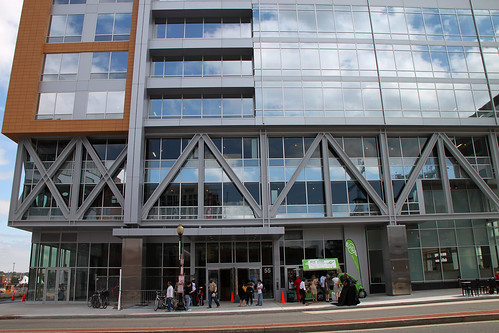
Artomatic 2009 55 M Street SE
55M, home of Artomatic 2009. Note the exposed diagonal supports and the
asymmetrical but still right-angle dominated façade.


I'm not a trained architect, tho I did present failed a bid for a Fulbright scholarship on postmodern monumentalization in Germany. So I feel especially well-qualified to write about this.

Much of what's built these days is given the moniker of postmodernism. This is not the place for a philological deconstruction of the term or it's nauseating overpresence in today's commentary, so I will only say that I think the term is somewhere between troublesome and abhorrent.


Bank Center, Houston. The shape suggests urban architecture in
the Netherlands, recalling Dutch financial dominance.
Postermodern architecture often references preexisting concepts
rather than copying them outright as is done in revivalism.


Postmodernism is our generation's rejection of 20th Century functionalism and it tries, sometimes desperately, to relocate the importance of ornamentation. It draws from the Brutalism that almost took over DC in the seventies, the high-tech exposure which still seems to frighten Americans, and the old standby international style that defines many American skylines.

L'Enfant Plaza Metro Station
Every underground Metro station features Brutalist style in the ceiling pattern.
Brutalism does not fail on it's theory – leaving artifacts of the form's construction is not
inherently bad – but in practice it seems to dominate entire structures, and it certainly
dominated Washington's last urban renewal after the riots. (The fearsomely ugly FBI
building
is another prominent example).


Although that pedigree is clear at the Waterfront, there is no revivalism and no homage on display in this development. (That's not a judgment, just a statement.) The materials are cutting edge and the form reflects this. The capabilities of the material allow for hints of the underlying structure and process of the building to show thru, suggesting a sort of neo-Brutalism or neo-high-tech. However, unlike Brutalism and high-tech, these styles are not the focus of the building, but only possibilities. The brackets that hold the windows are capped with stainless steel. The elevator is visible, but its machinery is tucked away.


Postmodern additions add contemporary functionality to history structures.
Left: New DC Court of Appeals at Judiciary Square. The postmodern atrium obviously alters the form from its original. It defaces the historic building but does not offend it.
Right: Nevada State Museum, Carson City. I haven't seen this in person yet, tho I'm excited to get the chance. It's one of the coolest museums anywhere (not being ironic!) and I want to feel how it works.


So all we have left to describe what we see is postmodernism. And it feels so... unsatisfying. Why do I like this style at Judiciary Square, and why am I excited about it at the Nevada State Museum, but it feels so sickly and sterile at the Waterfront? Part of my frustration, I think, is that the style has no inherent life – a fact made clear when you walk thru the empty lobby of 55M. Flat light seeps thru the glass or plastic walls of the room, ensuring no corner is hidden in shadow. Marble, wood and brass, materials prevalent in the decadent neo-classical government buildings, is non-existent here. In theory, this should create a sense of egalitarianism in the space, where the people are foremost, but I suspect that in practice this forces the people to architecturalize themselves. The seams of their pants, the cut of their décolletage, the tattoos on their skin must provide the context.


Sadly, this is not the Rotunda of the Capitol, where Americans of every type gather to observe and interpret their collective self. In its attempt to move beyond the nostalgia of repeatniks and conservatives, it has created a lifeless fashion runway that only waits for models and designers to fight over their individuality. It creates competition, not community.

The art inside the building, however, is great and I'm excited to head back tonight and tomorrow!

I'm tired of these posers!

There's been a lot of talk about Republicans and infidelity lately, like John Ensign and Mark Sanford invented the horny conservative genre.

Bullshit!

I do respect the Silver Fox's attempt to take the crown from California's reigning champ, Gavin Newsom. There are few things scumbaggier than gettin' it on with your friend's wife. Such drama, however, is so pedestrian it's featured in Greek plays. Way to be original, Senator.

And as for poor Governor Sanford, I think he's just livin' his life like its a Barry White song. It's going to be a long time before another pol of either party brings that kind of sexuality and emotion to a press conference. He may yet send Danielle Steel into early retirement, but he is not big pimpin'.

The most gangsta Republican of our generation remains the one-of-a-kind Nevadan, Jim "LuvGuv" Gibbons (with a big thank you to Dullard Mush for the tip):
Anyway, a friend of ours was recently at a new south Reno Mexican restaurant when Governor Jim Gibbons and an entourage arrived. The bartender there apparently was quite familiar with Nevada's Guv as she ran up and gave him a big 'ol lusty hug. Not only did Gibbons heartily return the favor, but his paws quickly headed south -- the deep south. So while my friend was getting an eyeful, our Governor was getting a handful. It obviously wasn't the first time, and probably not the last either.

Well, at least this tail-grabbing incident was consensual.

That's how it's done.
~~~

Special Note to AnonGuy: I understand your hesitation to dogpile on the Party, but don't think of it as a cheap shot against the GOP. Think of it as doing a solid for Mike Montandon. (Whose logo makes excellent bling, btw.)

I hope RedState didn't notice this

I think I just saw the Human Rights Campaign logo in an Orbitz commercial.

Four guys are are golfing and the refund guy shows up in his hovercraft. It looks like the logo at right is embroidered on one of the guys' polo shirts.

Any confirmation?

Update: Holy smokes, I was right!

BLOGGERFIGHT!!!

I have very few personal views on the California budget crisis. I'm bad with numbers. But I couldn't resist writing about the online slapfight between David Dayen of Calitics and Phil and Jerry at Calbuzz.

It all started when the Commission on the 21st Century Economy (a.k.a. the Parsky Commission) started putting forward some proposals that would include a flat(ish) tax and replace the corporate tax with a net revenues tax. Calbuzz provided an analysis that pointed out the difficulty of getting consensus on such thorny issues.

Calitics, however, called the proposals crazy right-wing insanity,
the real shock doctrine is happening behind the curtain, with a proposal engineered with bipartisan support, that will really permanently turn the state into an experiment in Chicago Boys free-market fundamentalism, not unlike the conservative "paradises" created in developing nations, all of which are crashing, by the way.

Arnold Schwarzenegger is NOT Pinochet, but I get the Chicago Boys metaphor nonetheless. Taking advantage of political expediency, he is importing minions to enact extreme economic experiments that could overthrow the established liberal order.

But they raised Calbuzz's ire by calling them "useful idiots" who enable such extremism by advocating the moderate path.

Calbuzz responded by lampooning Calitics' hyperbole with some of their own,
As regular readers of Calitics, we admire your passion, if not your common sense. But let’s be clear that our mission at Calbuzz is quite different than the ideological ranting that is your stock in trade: it’s called “journalism.”

Let’s be blunt: You knew bupkus about the maneuvering and politics unfolding behind-the-scenes at the tax commission until we started covering it. To attack us for digging out the story is to mistake the map for the territory, using the same kind of tiresome, rigid, WATB ideological projections as you decry in the Yacht Party.


I don't think Calitics was behaving like a "whiney ass titty-baby," but they were certainly reacting from one end of the political spectrum. It could've stopped there, with Calbuzz claiming the moderate position against Calitics' unapologetic progressivism. But it didn't. Calitics re-reacted to Calbuzz's critique-of-their-critique with a classic ad hominem attack,
Unlike you, I don't pretend to hide my opinions on the very clear economic and tax policy implications of the Commission's report behind some false veil of objectivity. Most of my comments were directed at the report itself, and the way in which a flat tax would quite obviously shift the burden of taxation to the middle class and the poor; but I couldn't help but notice clear language like...
the impending bankruptcy of state government should be sufficient to show players at every point of the political spectrum not only that sweeping change is needed, but also that everyone will have to compromise to keep California from sinking into the 9th Circle of Hell

...which certainly allows people, in my view, a window into how you determine the best policy, defined as the midpoint between whatever pleases those hateful hippies and the ranters on the right. That may be a nice and quick methodology, but it's anything but rigorous, and I'm pretty sure it's an apt description. After all, wasn't one of you the communications director for Gray Davis, who was not above bold expressions of centrism and a fear of the spectre of "The Left"?

(How did pumping out that daily message for ol' Gray turn out, by the way? What did that guy do after his two successful terms were up? Just curious.)

Wow. David Dayen does not like Gray Davis, I guess.

This exchange highlights the upcoming war within the Democratic establishment over how to respond to the voters' rejection of the budget compromise. Moderates will argue that the disaster at the ballot box shows Democrats need to be open to a fundamental change in California's revenue system. Progressives will argue that the result shows Californians are fed up with revenue neutral solutions and they want a real change.

To put this simply, California is majority Democratic, but not majority liberal. While some well-meaning activists on the left see this as an opportunity to install a social democratic economic system in the biggest state in the U.S., there remains an aggressive and electorally viable plurality that does not believe the conservative revolution is over yet.

There are technocratic debates that need to be had, of course, but they won't happen here (or on any other blog). Rather than seeing progressive Democrats and moderate Democrats go at one another's throats, I would like to see them rally behind what I believe is their unifying value which generates California's Democratic majority.

Namely, the political system should put the preferences of the welfare state before the preferences of the tax structure. What I mean is, the purpose of democracy should be to measure the types and levels of government service demanded by the people, then it is the responsibility of elected officials to extract the revenue necessary to meet those demands. To reverse that model as conservatives do - measure the people's tax preferences then design the government structure that is affordable under that preference - devalues democratic government.

Government of the people is more than a cost-benefit analysis or a necessary evil, it is an open-source forum, the first, final, and only arena where the differences among individuals and communities can be resolved through passionate discourse instead of political violence.* It is the closest we have to a society-wide family, and like your family it is more than the sum of its economic parts.

*The space between those two is often narrow but it always exists, it must exist.

Ensign

I wasn't planning on writing this post, but the window of opportunity to do so is closing fast.

You already know the details: Senator Ensign admitted to having an affair with a staffer while separated from his wife, who worked for Ensign's campaign and the NRSC and whose husband was a close adviser. As Washington sex scandals go, this one rates a *yawn*.

I am confused by the presidential talk, though. I've never heard it mentioned as anything more than cocktail party speculation. The evidence for such a scenario is
  1. Ensign gave a speech in Iowa.
  2. Ensign's been burnishing his conservative credentials.
  3. This confession will clear the air for 2012.

The day after the revelation, Ensign resigned his leadership posts. Maybe that gives him more latitude to position himself - it's hard running for President when you've got leadership responsibilities. But my theory was that he was working his way up Senate leadership, not a presidential run.

There may be more to come from this story but this is pure speculation on my part. I don't want to add any more salaciousness to the already oversexed Series of Tubes.

For Nevada, nothing really has changed. Ensign is not the new LuvGuv. In the Governor's case, his escapades are a metaphor for more serious bipartisan frustration with his performance. I don't think that is the case with Ensign.

Perhaps this opens up the possibility for a more serious primary challenge, and I would watch the GOP gubernatorial primary in case it provides strong 'leftover' candidates who need another white whale to hunt. But if the Reid re-election and the Governor's race don't bring out the hungry young lions of the GOP, I don't know what will.

I'm sure that Dina Titus, however, is watching this all unfold with interest.

Europe won't stop being socially progressive

I don't want it to sound like I think I'm smarter than Robert Kuttner at The American Prospect but in his column on Huffington Post today Kuttner makes many of the same damn errors in analyzing European political trends that so many in this country make. Primarily, he's trying to make Europe be a prop for the American left.

Here's the gist of his argument: the European left co-opted the market liberalizations of the last 25 years and have thus lost their ability to serve as a viable opposition to nationalist and conservative parties, thus endangering Europe's sweet sweet welfare state.

In Kuttner's own words,
For a generation, the European center-left has embraced essentially the same version of global laissez-faire and liberated finance as the center-right parties, tempered by only a marginally better version of the welfare state. The common formula is: liberalized capital markets; freer global trade; reduced protections for workers; flatter taxes. The very phrase, "center-left" is an emblem of the capitulation to global finance. Thus, leading moderately left parties have scant alternatives to offer voters at a time when free market capitalism has thoroughly disgraced itself.

First, free market capitalism hasn't throughly disgraced itself, unregulated speculative financial schemes have disgraced themselves, as they do from time to time.

Otherwise, Kuttner's got it about right, with a few caveats. The liberalization of capital markets, at least within Europe, has been an offshoot of the Eurozone and is an expression of Europe's greater social unity, not a corruption of it. Similarly, Europe's position supports free movement of goods but, because it is the largest trading entity in the world, the rules of trade are often set by Europe, so again this isn't tearing Europe apart, it's building it up. Although corporate taxes in post-war Europe have dropped a lot, income taxes remain highly progressive, and labor reforms, like Germany's Hartz IV, remain the toughest political knots to cut. Although it's not classical socialism, it's also not the 1960's anymore. The goal is solidarity now, and Europe's doing quite well at that.

Kuttner's concern for Europe's degrading social systems is unfounded. He further demonstrates unfamiliarity with Europe's political structures when he says,
The EU, once a possible instrument of social democracy on one continent, itself has become something of a Trojan Horse. Its basic document, the Maastricht Treaty, makes free movement of capital, goods, services, and persons a core constitutional doctrine. Social protections are secondary.

Again, fundamental error: the Maastricht Treaty is not the EU's basic document, although it is the document containing several of the institutions we associate with Europe, such as the Euro currency and the European Parlament. Social protections were certainly left out of Maastricht, largely at the insistence of the United Kingdom, to ensure that members at the periphery would not be weighed down by the heavy social systems of the 'engine' of Europe's economy, Germany.

The reason this was acceptable, and preferable to many members in retrospect, is because the social contract of every European country is radically different from America's in one important aspect. The European central state is obligated to maintain the welfare of the citizen. The level of welfare and the means of maintenance vary from one state to the next, but the equation is homogeneous. The state keeps people out of abject poverty and the people stop overthrowing the state. To protect that way of life, Europe has focused on establishing solidarity among the Members, keeping each from meddling in or undermining the others' welfare arrangements.

Kuttner should be thrilled that, in the face of globalization, Europe has found a way to nurture the cherished welfare states of its Members. Instead, he wrings his hands over the left's shoddy performance at the polls. It is true that the right has gained considerable control of the EP and that center-right parties have been successful across the continent. But here again he is conflating European political behavior with America's. Like in the U.S., there are numerous local representative bodies and one central body. They remain independent and assume different responsibilities. In Europe, however, the roles are reversed, with the central body representing local interests.


Case in point, Strasbourg has been the scene of a new strain of European politics, euroskepticism, representing voters' dissatisfaction with Europe's highhanded attempts to co-opt the prerogatives of their countries. Initially it may seem ironic, like sending a states-rightist to Congress, but where else would you want your anti-centralization representative to be? Indeed, the Council and the Commission have been the strongest proponents for greater harmonization among the Members, even in social matters, regardless of whether the constituents of the Council are largely from the right. It's only natural that opposition to this process would find refuge in the Parliament.

Another phenomenon Kuttner doesn't pick up on is the sad state of European liberalism, or what we in the U.S. call libertarianism. The liberals, such as Germany's FDP, were the kingmakers of Europe's post-war political systems. They kept governments of the left from sliding into socialist inefficiency and they kept governments of the right socially conscientious. While the liberal parties are not dead, they've lost much of their ability to influence government, so their ideas have been sold off like outdated furniture at a flea market. The remnants of liberalism have not been fully absorbed into the other party institutions, or they were co-opted by the 'wrong' half, leading to socially liberal nationalists like the Jacques Chirac and free marketeer socialists like Gerhard Schröder.

Other, weirder combinations are possible and likely in the future. Europe's political dynamics have undergone tectonic changes since the fall of the Wall, with longstanding constellations evolving, radically changing their character, or disappearing altogether. The EP's conservative trend is part of this continent-wide process. It's difficult to predict where it will end up or even if the change is going to stop; change could be the new European constant. In the short run, it's a safe guess that euroskepticism (encompassing whatever that signifies) will play a dominate role in European politics, but the end of the contitent's unrivaled social systems is definitely not nigh.